Recently, several institutions released the latest data on the UK property market. The data indicates that, influenced by high interest rates, energy costs, and global economic uncertainties, the UK housing market has entered an adjustment phase in 2026, yet the rental market continues to see growing demand, with some regions still displaying strong resilience. For investors planning to purchase property in the UK, allocate overseas assets, or implement the "support studies through property investment" strategy, does the current market mean risk or opportunity? UK lansha combines the latest market data to outline the latest trends in the 2026 UK real estate market for everyone.
The latest data shows that in May 2026, the average house price in the UK fell by 0.6% month-on-month, and the annual growth rate slowed down from the previous 3.0% to 1.7%. The market generally expects an adjustment of around 2% for overall UK house prices in 2026.
The primary reasons for the slowdown in house prices include:
1. Mortgage rates remaining at high levels
2. Decline in buyer affordability
3. Continuous increase in the cost of living
4. Enhanced global economic uncertainty
Particularly in high-priced areas like London, the impact of financing costs is more pronounced. However, in the long run, most institutions remain optimistic about the future development of the UK housing market. Market forecasts show:
* UK house prices are expected to resume growth in 2027.
* The market will enter a steady upward phase from 2028 to 2030.
* The cumulative growth of UK house prices over the next five years is projected to reach 18.5%.
This means the current market behaves more like a cyclical adjustment rather than a systemic decline.
Although house price growth has slowed down, the mortgage market has shown strong resilience. Data reveals:
* In April 2026, the volume of new mortgage approvals reached 65,900 cases , hitting a new high in nearly 15 months.
* Refinancing loan approvals reached 51,260 cases , the highest level since 2022.
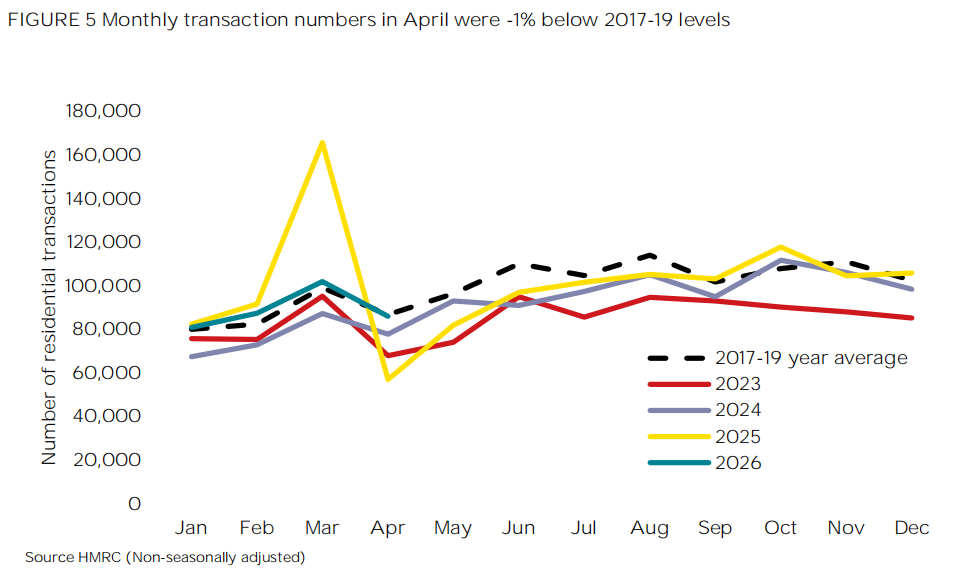
Market insiders believe that a large number of buyers are locking in current interest rate levels ahead of time to hedge against potential interest rate fluctuations in the future. From transaction data, UK residential sales reached 85,880 cases in April 2026, which is only about 1% lower than the pre-pandemic average , indicating that no widespread wait-and-see sentiment has emerged in the market.
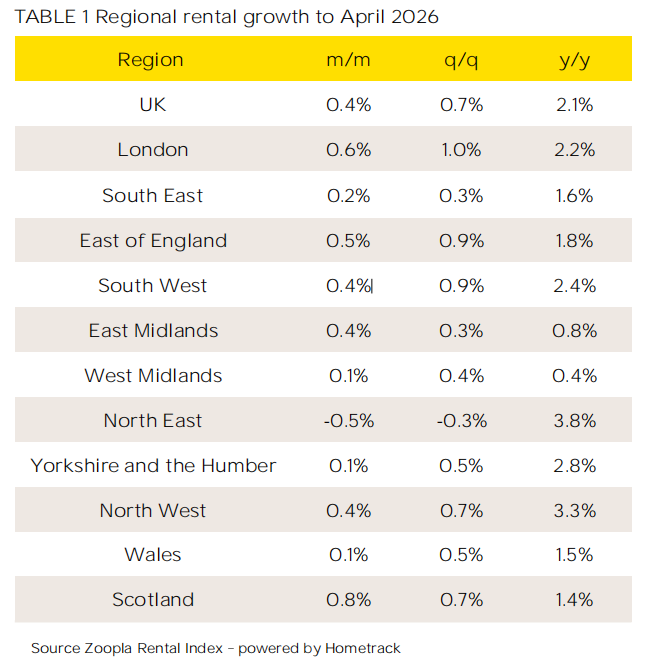
Compared with the adjustment in the sales market, the UK rental market maintains robust growth. Data shows that in April 2026, the average rent in the UK rose by 2.1% year-on-year.
Certain regions experienced even higher increases: Region, Annual Rent Increase North East, 3.8% North West, 3.3% London, 2.2% South West, 2.4%
Meanwhile, tenant demand has reached a near one-year high, while landlord supply continues to decrease. Market surveys show that the rental demand index stands at +13, whereas the landlord supply index dropped to -22. The supply-demand imbalance is driving rents continuously upward. For investment buyers, rising rents generally mean a more stable cash flow return.
Looking at regional performance, the UK property market is showing clear differentiation.
Strong-performing regions include:
1. Scotland: Some areas saw house price increases of over 9%.
2. North West England: Benefiting from employment growth and higher rental yields, it outperformed the national average.
Conversely, some traditional high-value areas in London experienced declines:
* Brent dropped by approximately 6.5%.
* Kensington & Chelsea fell by about 5.6%.
The main reason is that high-total-value properties are more sensitive to financing costs. However, it is worth noting that prime central London still possesses the UK's strongest population influx, educational resources, and job market. For long-term investors, the current adjustment phase might instead provide a better entry window.
From the perspective of the market cycle, the UK housing market is currently in a phase of "house price adjustment + rising rents + long-term bullishness".
For different types of buyers:
* Owner-occupier buyers: The current market offers increased room for negotiation and more options of available properties.
* Families of international students: Properties in core school districts and around universities still retain strong value-preservation capabilities. Through the "support studies through property investment" model, long-term rental expenses can be effectively reduced.
* Investment buyers: The rental market continues to see supply falling short of demand, with cash flow performance beating the past few years. Cities such as Manchester, Liverpool, Birmingham, Leeds, and Glasgow, in particular, still maintain relatively high rental yields.
The UK real estate market is undergoing a short-term adjustment, but this has not changed the long-term supply and demand relationship. Considering population growth, housing shortages, international educational resources, and global capital allocation demands, the UK remains one of the most mature and transparent real estate markets globally.
At the current stage, house price growth has slowed, buyers' bargaining power has enhanced, and the rental market remains strong. For investors with long-term holding plans, this is instead an important window period to reconfigure UK assets.
UK lansha has been deeply rooted in the UK real estate market for over a decade, with a cumulative transaction volume exceeding 1.5 billion GBP. Its scope of services encompasses: UK new build investment, secondary market transactions, international student housing, study-by-property planning, property management, UK mortgage services, and overseas asset allocation. If you would like to know about the latest investment opportunities in popular cities such as London, Manchester, and Birmingham, please feel free to contact the professional consultant team at UK lansha for one-on-one advisory services.