In today's UK housing market, the phrase 'Bank of Mum and Dad' (BoMaD) has shifted from a colloquialism into a structural pillar of residential property acquisition. Driven by elevated house-price-to-income ratios, stringent affordability testing by mortgage lenders, and persistent cost-of-living challenges, first-time buyers (FTBs) increasingly rely on financial contributions from parents or family members to secure a foothold on the property ladder.
While financial assistance from family is invaluable, navigating the UK property buying process involves far more than simply transferring money into a child's current account. Under the UK's legal and financial regulatory framework, family contributions trigger compliance checks, mortgage underwriting criteria, tax considerations, and potential legal exposure for both the donors and the recipients. This guide provides a detailed breakdown of how the 'Bank of Mum and Dad' operates within the UK real estate landscape, highlighting key procedural steps, regional variations, tax implications, and strategic considerations.
Industry research indicates that if the Bank of Mum and Dad were a formal lending institution, it would consistently rank among the UK's top ten largest residential mortgage providers. Family financial contributions support roughly half of all first-time buyer transactions nationwide, representing billions of pounds in capital deployment annually.
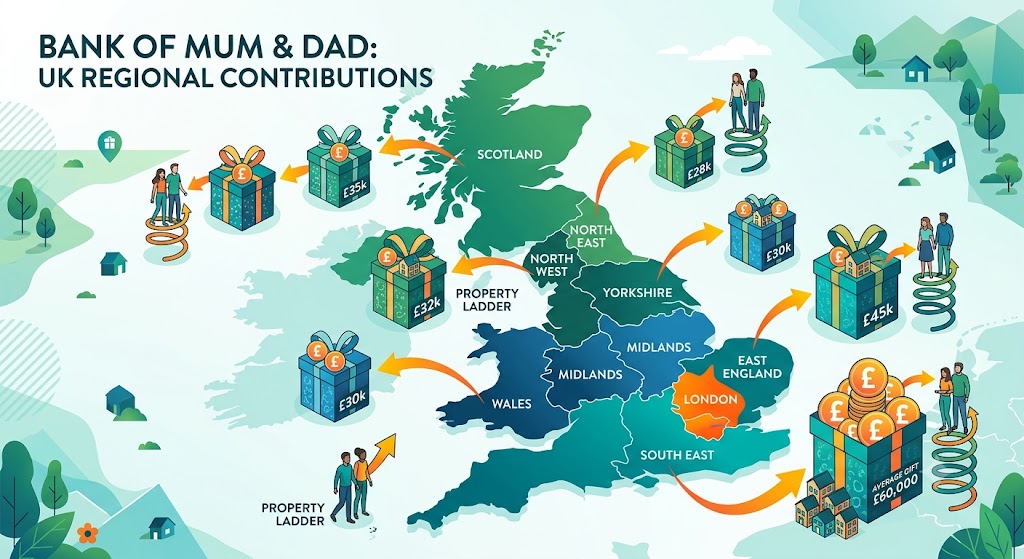
However, the extent of family reliance varies significantly across different regions of the UK, reflecting stark differences in property valuations and local wage economics:
· London and the South East: Due to extreme property price multiples, buyers in London and the Home Counties face the largest deposit gaps. Average family contributions in these areas frequently exceed £55,000 to £60,000. Without family assistance, even high-earning professionals often fail lender affordability assessments or take significantly longer to accumulate necessary funds while paying private rent.
· The Midlands and North of England: In cities such as Manchester, Leeds, and Birmingham, lower average purchase prices mean typical family contributions range between £20,000 and £35,000. Here, family gifts are often leveraged to unlock lower Loan-to-Value (LTV) brackets—such as moving from a 90% LTV to an 80% or 75% LTV mortgage—which substantially reduces monthly interest repayments.
· Scotland and Wales: Region-specific property purchasing mechanisms, such as Scotland's 'Offers Over' bidding system and separate property transaction taxes (Land and Buildings Transaction Tax in Scotland, Land Transaction Tax in Wales), require careful timing when structuring gifted funds. In Scotland, gifted funds may also be needed to cover the gap between a property's Home Report valuation and the final agreed purchase price, which cannot be funded via a standard mortgage.
To ensure a property purchase proceeds smoothly without delays at the conveyancing or mortgage application stage, family buyers must adhere strictly to UK regulatory protocols.
Under the Money Laundering, Terrorist Financing and Transfer of Funds Regulations, UK conveyancing solicitors and mortgage lenders are legally obligated to verify the origin of all funds used in a real estate transaction. When family members contribute money toward a purchase, they must undergo the same Anti-Money Laundering (AML) and Know Your Customer (KYC) checks as the buyer.
Parents or donors should be prepared to provide:
· Official photo identification (e.g., valid passport or photocard driving licence).
· Proof of address (e.g., recent utility bill or bank statement issued within the last three months).
· A clear audit trail of the funds (e.g., 3 to 6 months of bank statements showing how the capital was accumulated, evidence of property sale completion, equity release documentation, or probate statements for inherited wealth).
Compliance Warning: Lenders and solicitors require funds to be fully traceable. Transferring money across multiple unverified accounts right before a purchase can trigger anti-money laundering flags and lead to transaction delays. Maintain clean, unbroken bank records for all gifted capital. |
Mortgage lenders require complete clarity regarding whether family funds are an unconditional gift or an unsecured loan. Lenders will rarely allow a standard residential mortgage if a portion of the deposit is an informal loan that requires repayment, as this additional debt alters the buyer's debt-to-income ratio.
Consequently, parents donating money are typically required to sign a formal Gifted Deposit Letter (also referred to as a Deed of Gift). This document legally confirms that:
· The money is an absolute, non-refundable gift.
· The donor expects no repayment under any circumstances.
· The donor acquires no legal title, financial interest, or right of occupation in the property.
Navigating family contributions requires an understanding of UK tax frameworks and property ownership structures to prevent unexpected liabilities or disputes later on.
In the UK, financial gifts made to children for a property purchase generally fall under the category of Potentially Exempt Transfers (PETs) for Inheritance Tax purposes.
· The 7-Year Exemption Rule: If the parent or donor survives for seven full years after making the gift, the money falls completely outside their estate for Inheritance Tax purposes, regardless of the amount.
· Taper Relief: If the donor passes away within seven years of making the gift, and the total value of gifts made exceeds the donor's tax-free threshold (£325,000 nil-rate band), Inheritance Tax may be charged on a sliding scale (Taper Relief) ranging from 40% down to 8%, depending on the time elapsed between the gift and death.
· Annual Allowances: Every individual in the UK has an annual gift allowance of £3,000 that is immediately exempt from IHT. Unused allowance can be carried forward for one tax year, allowing a couple to gift up to £12,000 combined tax-free in a single tax year if no previous gifts were made.
A common scenario involves a young buyer purchasing a home jointly with a partner, friend, or spouse using funds provided solely by one set of parents. Without explicit legal protection, gifted capital could be treated as a joint asset in the event of a relationship breakdown.
To safeguard family capital, buyers and donors should consult their conveyancer regarding the following structures:
· Tenants in Common: Rather than holding the property as 'Joint Tenants' (where both parties own an undivided 100% share), the buyers register as 'Tenants in Common'. This allows ownership shares to be divided unevenly (e.g., 70/30) to reflect unequal deposit contributions.
· Deed of Trust (Declaration of Trust): A legally binding agreement drafted by the conveyancing solicitor specifying exactly how equity will be distributed upon sale. It can state that the parent's gifted deposit is returned first to the child who received it before any remaining equity or capital growth is split between co-owners.

For parents who want to assist their children but cannot afford an outright gift or wish to preserve their capital for retirement, several alternative UK mortgage products exist:
· Guarantor / Joint Borrower Sole Proprietor (JBSP) Mortgages: A JBSP agreement allows parents to add their income to the child's mortgage application to boost borrowing capacity without adding their names to the property title deeds. This avoids triggering the 3% Stamp Duty Land Tax (SDLT) surcharge for owning an additional residential property.
· Family Offset Mortgages / Savings-Backed Mortgages: Parents place savings into a linked account held by the mortgage lender. These savings act as security for the child's loan, allowing the child to secure a lower interest rate or buy with a smaller deposit, while the parents retain ownership of their savings, which are unlocked once the child pays down a specified portion of the mortgage.
· Equity Release / Lifetime Mortgages: Older homeowners may unlock tax-free equity from their primary residence to fund a child's deposit. However, this must be evaluated carefully due to compound interest costs and potential impacts on retirement estate planning.
To ensure a seamless transaction and preserve family harmony, consider the following step-by-step roadmap when utilizing the Bank of Mum and Dad:
1. Hold Open Discussions Early: Agree on the exact sum, timeframe, and whether the funds are a gift, loan, or ring-fenced contribution before viewing properties.
2. Audit Retirement Security: Parents should perform a thorough financial check to ensure gifting capital does not compromise their long-term retirement plans or care needs.
3. Engage Professionals Early: Instruct an independent financial adviser (IFA) and a qualified conveyancer early in the process to draft necessary Deeds of Trust and Gifted Deposit Letters.
4. Organize Financial Documents: Collate bank statements and proof of fund origins at least three months prior to submitting a formal mortgage application.
Disclaimer: This document is provided for informational and educational purposes only and does not constitute formal legal, tax, or financial advice. Readers should consult a regulated Independent Financial Adviser (IFA) and a qualified conveyancing solicitor for personalized advice regarding UK property transactions.