Navigating the UK property market can often feel like a daunting endeavor, particularly for first-time buyers aiming to step onto the property ladder or established homeowners looking to optimize their finances. At the core of almost every property transaction is the mortgage. But what exactly is a mortgage, and how does it function within the intricate framework of the United Kingdom's financial system?
In its simplest definition, a mortgage is a type of long-term financial loan specifically designed to help individuals purchase a house, flat, or other forms of real estate. Because property prices usually exceed what an individual can pay upfront in cash, a mortgage bridges the gap. However, it is not merely a personal loan; it is a secured loan. This means the loan is legally secured against the value of the property you are purchasing. If the borrower fails to keep up with the agreed-upon monthly repayments, the lender holds the legal right to repossess the property to recover the outstanding debt.
Typically stretching over decades, mortgages allow homeowners to spread the enormous cost of a property over a manageable timeline. Understanding the diverse types of mortgages, how interest rates are applied, and the step-by-step application mechanics is absolutely crucial for any prospective buyer, seasoned investor, or property management brand looking to excel in the UK real estate ecosystem.
Before diving into the specific products available, one must understand two fundamental metrics that govern every UK mortgage agreement: the mortgage term and the Loan-to-Value (LTV) ratio.
When a borrower takes out a mortgage, they agree on a specific 'mortgage term' with the lender. This term represents the total lifespan of the loan—the pre-agreed period over which the borrower promises to pay off the borrowed capital along with all accrued interest and associated fees.
Historically, the standard mortgage term in the UK has been 25 years. However, as property prices have risen compared to average incomes, a growing number of borrowers are opting for longer terms, sometimes extending to 30, 35, or even 40 years. Extending the mortgage term makes the monthly repayments more affordable because the capital debt is spread out over a longer timeline. However, the critical trade-off is that a longer term results in a significantly higher total cost of borrowing, as interest is charged over a more extended period. Conversely, opting for a shorter term increases monthly financial pressure but drastically reduces the total interest paid. Many lenders also allow borrowers to make overpayments—typically up to 10% of the outstanding balance per year without incurring an Early Repayment Charge (ERC)—which helps clear the debt faster.
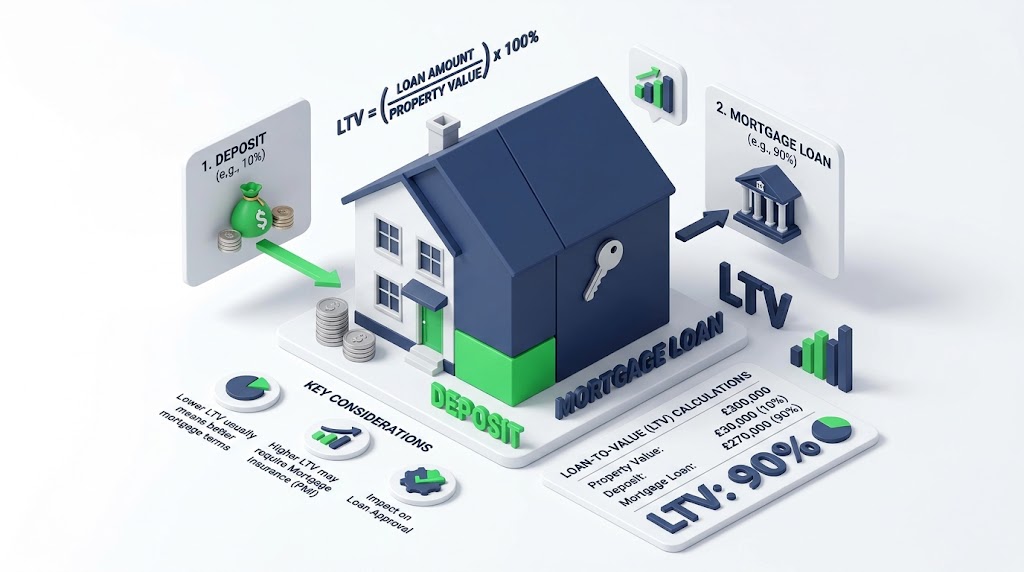
The Loan-to-Value (LTV) ratio is the mathematical relationship between the amount of money you need to borrow and the total purchase price (or appraised value) of the property. It is expressed as a percentage. For example, if you are purchasing a house for £200,000 and you have saved a £20,000 deposit (which is 10% of the property's value), you will need a mortgage of £180,000. Your LTV is therefore 90%.
In the UK property market, the LTV is the primary driver of the interest rates offered to you. Lenders perceive high LTV mortgages (such as 95% LTV, requiring only a 5% deposit) as higher risk, and consequently, they charge higher interest rates to offset that risk. Borrowers who can provide a larger deposit—bringing their LTV down to 80%, 75%, or even 60%—are rewarded with much lower interest rates and a broader array of mortgage products.
Once the funds are advanced and the property purchase is finalized, the borrower must begin making monthly repayments. In the UK, there are two primary methods for repaying a residential mortgage: Repayment (Capital and Interest) and Interest-Only.
A repayment mortgage is overwhelmingly the most common structure for standard residential homeowners. Each monthly payment is split into two parts: a portion goes toward paying off the interest charged on the loan for that month, and the remainder goes toward paying down the actual borrowed capital.
In the early years of a repayment mortgage, a larger proportion of the monthly payment covers the interest. As the years go by and the outstanding balance decreases, more of the payment goes toward clearing the capital. The absolute advantage of this method is the guarantee that, provided all monthly payments are made in full and on time, the mortgage will be completely cleared at the end of the term, leaving the borrower with 100% equity and outright ownership of the property.
With an interest-only mortgage, the borrower's monthly payments only cover the interest charged by the lender on the borrowed amount. Because none of the original capital is being repaid during the mortgage term, the monthly payments are significantly lower. However, at the end of the term, the borrower still owes the exact amount they originally borrowed as a single lump sum.
Interest-only mortgages are heavily restricted for standard residential buyers in the modern UK property market. Lenders require strict proof of a viable 'repayment vehicle' (such as an investment portfolio, stocks and shares ISA, or other assets) that will reliably generate enough cash to pay off the capital lump sum at the end of the term. While rare for standard homeowners, interest-only mortgages remain highly prevalent in the Buy-to-Let (BTL) market, where landlords use rental income to cover the interest and rely on the property's capital appreciation over time.
The exact amount a borrower pays each month is heavily dictated by the type of interest rate applied to their mortgage. The UK market offers several distinct interest rate structures to cater to different risk appetites.
A fixed-rate mortgage guarantees that the interest rate—and therefore the monthly payment amount—will remain exactly the same for a specified introductory period, regardless of broader economic fluctuations. The most common fixed periods are 2, 3, or 5 years, though 10-year and even longer fixed rates have become available.
Fixed-rate mortgages are incredibly popular because they provide ultimate financial certainty; borrowers know exactly how much will leave their bank account each month, making budgeting straightforward. The downside is that if national interest rates fall significantly during the fixed period, the borrower is locked in and cannot benefit from the cheaper rates without paying substantial Early Repayment Charges (ERCs) to break the contract.
A tracker mortgage features a variable interest rate that directly 'tracks' an external economic indicator—almost exclusively the Bank of England (BoE) Base Rate—plus a set percentage. For instance, a deal might be structured as 'BoE Base Rate + 1.5%'.
If the Bank of England lowers the base rate, the borrower's mortgage rate immediately drops, and their monthly payments decrease. Conversely, if the Bank of England raises the base rate to combat inflation, the mortgage rate and monthly payments will increase in tandem. Tracker mortgages are ideal for borrowers who can absorb potential payment increases but want to capitalize on a low or falling interest rate environment.
Every mortgage lender maintains a Standard Variable Rate (SVR). This is the lender's default interest rate, which they can increase or decrease at their own discretion (though it loosely correlates with the wider economy). When a borrower's initial introductory deal (such as a 2-year fixed or 2-year tracker) expires, they are automatically transitioned onto the lender's SVR.
The critical caveat for UK borrowers is that the SVR is almost always significantly higher than the competitive rates offered in introductory deals. Lingering on an SVR can cost homeowners thousands of extra pounds a year, which leads directly to the widespread practice of remortgaging.
Remortgaging is the process of switching your existing mortgage to a new deal, either by remaining with your current lender (often called a 'product transfer') or by moving to an entirely new lender.
The primary driver for remortgaging in the UK is to escape the costly Standard Variable Rate (SVR) when an initial fixed or tracker period ends. By continuously remortgaging onto new fixed or tracker deals every few years, borrowers ensure they are always paying competitive interest rates.
Furthermore, remortgaging is frequently used to release equity from a property. If the property's market value has increased, or if the borrower has paid off a significant chunk of the capital, they can remortgage at a lower LTV to unlock cash for home improvements, debt consolidation, or a deposit for a Buy-to-Let investment.
Securing a mortgage requires preparation and an understanding of the banking sector's strict underwriting criteria. Here is how the process generally unfolds.
Before taking any action, prospective buyers must assess how much they can realistically afford. Modern lenders conduct rigorous affordability assessments, stress-testing incomes against potential future interest rate hikes and analyzing everyday living expenses, existing debts, and childcare costs.
Sometimes referred to as a Mortgage in Principle or a Decision in Principle, an AIP is an official document from a lender indicating a willingness to lend a specified amount based on a preliminary assessment of the applicant's finances and credit score. Having an AIP is crucial when house hunting, as estate agents and sellers demand to see it to prove the buyer is financially credible and serious.
Once a property has been found and an offer accepted, the borrower submits the full mortgage application. This involves providing exhaustive documentation to the lender, including bank statements, payslips, P60s, and proof of address.
The lender will independently commission a property valuation to ensure the asset is actually worth the agreed purchase price and serves as adequate security for the loan. Simultaneously, the underwriter reviews all documentation to ensure the borrower meets all lending criteria.
If the valuation and underwriting are successful, the lender issues a formal, binding mortgage offer. The buyer's solicitor or conveyancer then handles the legal transfer of the property. On the day of completion, the lender transfers the mortgage funds to the solicitor, who pays the seller, finalizing the transaction and commencing the mortgage term.

While standard residential mortgages dominate, the UK market features specialist products tailored to specific demographics.
First-time buyers often struggle to amass large deposits. To assist them, lenders offer specific products—often supported by government schemes—that allow for 95% LTV borrowing. These products often come with additional perks such as zero arrangement fees or cashback upon completion, designed specifically to alleviate the heavy upfront costs associated with buying a first home, such as Stamp Duty Land Tax (SDLT) and legal fees.
A Buy-to-Let mortgage is strictly for purchasing a property to rent out to tenants. Unlike residential mortgages, where affordability is based on the borrower's personal income, BTL mortgages are primarily assessed based on the projected rental income the property will generate—known as the Interest Coverage Ratio (ICR). BTL mortgages usually require a larger deposit (typically 25% minimum) and are overwhelmingly structured on an interest-only basis, maximizing the landlord's monthly cash flow.
In summary, a mortgage is far more than a loan; it is a highly structured financial instrument that underpins the entire UK property market. From understanding the dynamics of Loan-to-Value ratios and mortgage terms to navigating the distinct advantages of fixed versus tracker interest rates, mastering this subject is imperative. Whether you are a first-time buyer saving a 5% deposit, a homeowner seeking to minimize costs through remortgaging, or a property professional optimizing real estate assets, understanding the intricate workings of UK mortgages is the foundation of long-term financial stability and success. Engaging with a qualified, independent mortgage broker or financial advisor is often the best step to safely navigate this complex, yet highly rewarding, landscape.