In the ever-evolving landscape of real estate investment and homeownership, purchasing property 'off-plan' has solidified its position as a compelling, yet complex, strategy. Across bustling metropolises, emerging markets, and suburban developments, skylines are frequently dotted with cranes and scaffolding, symbolizing future communities that have often been sold long before the first brick is laid. But what drives individuals and institutional investors to commit substantial financial resources to a physical asset that does not yet exist?
Buying off-plan refers to the process of purchasing a residential or commercial property before its construction is completed, and frequently, before it has even commenced. In these scenarios, buyers make their decisions based on architectural blueprints, computer-generated imagery (CGI), scale models, floor plans, and the historical track record of the property developer. This method of transaction is fundamentally a forward contract in the real estate sector. The buyer secures the right to a finished property at today’s predetermined price, while the developer secures the early capital and demonstrated market demand necessary to finance the construction and satisfy their lending institutions.
This comprehensive article will explore the multifaceted nature of off-plan property investments. We will delve deeply into the mechanics of the transaction, critically analyze the substantial advantages that draw investors to this model, and rigorously examine the inherent risks and disadvantages that can turn a lucrative opportunity into a financial burden. Furthermore, we will compare off-plan purchasing with traditional existing property investments and outline the critical due diligence required to navigate this intricate market successfully.
To fully grasp the advantages and disadvantages of off-plan property, one must first understand how the transaction typically unfolds. Unlike buying an existing home, where a mortgage is secured and the full price is paid upon transfer of deeds, off-plan purchases usually follow a phased payment structure.
The process typically begins with a reservation fee. When a buyer identifies a desirable unit—often during a highly anticipated 'launch' event—they pay a relatively small, sometimes refundable, reservation fee to take the property off the market. Shortly thereafter, contracts are exchanged, and the buyer is required to pay a more substantial deposit, usually ranging from 10% to 20% of the property's total purchase price. This is the point of no return, where the buyer is legally bound to the purchase.
Following the initial deposit, the payment structure can diverge based on the developer and the region. Some developers require staged payments tied to construction milestones (e.g., 10% when the foundation is laid, 10% when the roof is completed). Others offer 'post-handover' payment plans, allowing the buyer to pay the remaining balance over several years after moving into the property. The most common structure, however, involves paying the initial deposit upfront and settling the remaining 80% to 90% upon 'completion' or 'handover' of the property.
This delayed completion means that the buyer is locking in a purchase price today for an asset they will not take possession of for anywhere from 12 to 36 months, or sometimes longer. This time gap is the crucible in which both the greatest advantages and the most severe disadvantages of off-plan investing are forged.

The enduring popularity of off-plan real estate is driven by several compelling benefits that, when realized, can offer superior returns and lifestyle advantages compared to purchasing established properties.
The most potent magnet for off-plan investors is the potential for significant capital appreciation before the property is even habitable. Developers frequently incentivize early buyers by offering units at a discount compared to the projected market value of the completed project. This strategy is essential for developers, as they need to secure a certain percentage of pre-sales to unlock commercial construction loans from banks.
By purchasing early, the investor acquires the asset at the base price. As construction progresses and the development becomes a tangible reality, developers incrementally increase the prices of the remaining units. Furthermore, if the broader real estate market in that locale experiences natural growth during the 2-to-3-year construction period, the value of the off-plan unit rises in tandem. Consequently, by the time the keys are handed over, the property may be worth substantially more than the original contract price. This allows the investor to immediately realize capital equity, either by selling the property upon completion (flipping) or holding it for a higher rental yield based on the initial low capital outlay.
Financial flexibility is another hallmark of off-plan investing. When buying a resale property, a buyer typically needs a large upfront down payment and an immediate mortgage for the balance. Off-plan properties, conversely, allow buyers to stagger their financial commitments.
Developers often offer attractive, interest-free payment plans spread across the construction timeline. This allows buyers time to save funds, liquidate other assets, or manage their cash flow more efficiently without the immediate pressure of a traditional mortgage. In highly competitive markets, developers may even offer post-handover payment plans, where buyers can pay a significant portion of the property's cost over 3 to 10 years after moving in, essentially acting as an interest-free lender to the buyer.
The early bird gets the worm in off-plan real estate. Investors who buy at the very beginning of a project have the entire inventory at their disposal. They can select the units with the most desirable attributes: the highest floors, the most unobstructed views, optimal sun exposure, or strategic placement away from elevators and busy roads. These premium units are inherently more attractive to future buyers and tenants, ensuring better long-term performance for the asset.
Additionally, buying a home before it is built often affords the buyer a degree of customization. While structural changes are usually prohibited, developers frequently allow early buyers to choose their interior finishes. This might include selecting the color palette, flooring materials, kitchen cabinetry, and bathroom fixtures. This level of personalization is rarely available in resale properties without undertaking costly and time-consuming renovations.
An off-plan property is, by definition, brand new. This carries intrinsic value. Modern developments are constructed using the latest building materials, technologies, and architectural trends. They often feature state-of-the-art amenities such as smart home integrations, gymnasiums, co-working spaces, and advanced security systems—features that are highly sought after by modern tenants, thus driving up rental demand.
Furthermore, new builds generally come with robust warranties. Structural defects are typically covered for up to ten years, and internal fixtures are often guaranteed for one to two years. This significantly reduces the maintenance and repair costs for the buyer in the early years of ownership, providing peace of mind that is absent when buying older, aging properties.
Finally, modern construction regulations mandate stringent energy efficiency standards. New off-plan properties are generally much better insulated and utilize energy-efficient heating and cooling systems, resulting in lower utility bills and a reduced carbon footprint.
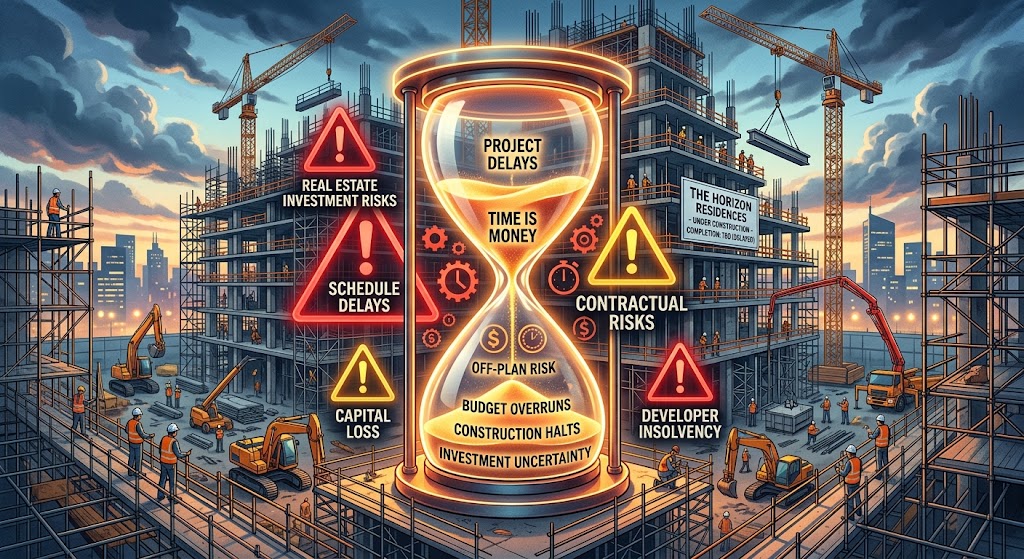
While the upside of off-plan investment can be lucrative, it is an inherently speculative endeavor. Buyers are exchanging current capital for a future promise, and bridging that gap involves significant risks that must be carefully evaluated.
The most ubiquitous and frustrating risk associated with off-plan property is construction delay. Real estate development is an incredibly complex logistical undertaking, susceptible to a myriad of external shocks. Disruptions in global supply chains leading to material shortages, sudden spikes in the cost of raw materials (like steel or cement), labor strikes, extreme weather conditions, or bureaucratic hurdles in securing necessary municipal permits can all derail a construction schedule.
Delays can have severe cascading effects on the buyer. If the investor is currently renting while waiting for their new home, a six-month delay means six months of unexpected rent payments. If the buyer is an investor relying on rental income to offset other financial obligations, delayed handover means a delayed return on investment. Furthermore, long delays can complicate mortgage approvals, as lending offers generally have strict expiration dates.
Just as a rising market can amplify an off-plan investment, a declining market can be devastating. Real estate is cyclical, and locking in a price today for a property to be delivered in three years exposes the buyer to market volatility.
If the broader real estate market enters a recession or experiences a downward correction during the construction phase, the property may be worth less upon completion than the agreed-upon purchase price. This creates a dangerous scenario known as a 'valuation shortfall'. When it comes time to complete the purchase, the buyer's mortgage lender will conduct a final valuation of the property. If the bank values the property lower than the original contract price, they will only lend against the lower valuation. The buyer is then forced to bridge the financial gap with their own cash, or risk defaulting on the contract and losing their entire initial deposit.
The most severe risk in off-plan buying is the financial collapse of the property developer. If a developer runs out of money, fails to secure adequate financing, or grossly mismanages the project's funds, they can go bankrupt before the building is finished.
When a project goes into administration, work stops, and the site is abandoned. Buyers who have paid significant deposits may find themselves embroiled in years of complex legal battles with liquidators to recover their funds, often walking away with only pennies on the dollar, if anything at all. While reputable developers are highly unlikely to fail, the risk is never zero, particularly during times of global economic stress.
When buying off-plan, the buyer relies heavily on marketing collateral—glossy brochures, idealized CGI renderings, and pristine show homes. However, the final delivered product may not perfectly align with these high expectations.
There may be discrepancies in the exact square footage, the quality of the finishes might feel cheaper than anticipated, or the promised sweeping views might be obstructed by another unexpected development. Furthermore, 'snagging'—the process of identifying minor defects and unfinished work upon handover (such as poorly applied paint, scratched tiles, or misaligned doors)—is a common frustration. While the developer is obligated to fix these issues, it can be a tedious and stressful process for the buyer.
Off-plan contracts can be difficult to exit. Unlike a finished property that can be listed on the open market, an off-plan contract binds the buyer to the developer. While some developers allow buyers to 'assign' or flip their contract to a new buyer before completion, they often charge hefty administration fees to do so, and many prohibit selling until a certain percentage of the purchase price has been paid. If a buyer's personal circumstances change—such as a job loss, divorce, or relocation—and they can no longer afford the final completion payment, they may be trapped in an illiquid asset.
To contextualize the off-plan model, it is helpful to compare it directly to the traditional route of purchasing an existing, pre-owned property.
Purchasing an existing property offers immediate certainty. What you see is precisely what you get. You can walk through the rooms, inspect the neighborhood dynamics, check the water pressure, and verify the noise levels. There is zero construction risk, and you can generate rental income or move in almost immediately after closing. Furthermore, historical data on the property's price fluctuations allows for a more accurate assessment of its market value.
However, existing properties require significant upfront capital. They may require immediate maintenance, renovations, or modernizations to meet the buyer's standards, adding unexpected costs. The energy efficiency is often lower, and they lack the warranties that protect buyers of new builds.
In contrast, off-plan properties sacrifice immediate certainty and liquidity for financial leverage, customization, and the potential for accelerated capital growth. It is a choice between a tangible, immediate asset with steady, predictable growth versus a speculative, forward-looking investment that requires patience but offers a higher ceiling for financial return.
Because off-plan investing carries distinct risks, rigorous due diligence is the most critical phase of the purchasing process. Investors should never rely solely on marketing hype; they must adopt an investigative approach.
First and foremost, thoroughly research the developer. Examine their track record. Have they successfully completed similar projects in the past? Did they deliver them on time? Most importantly, what is the quality of their finished buildings a few years post-handover? Visiting a developer's previously completed project and speaking to the residents can provide invaluable insights into their reliability and the long-term quality of their work.
Secondly, analyze the legal and financial structures safeguarding your investment. In well-regulated real estate markets, developers are required by law to place buyers' deposits into a secure, third-party 'escrow' account. The developer can only access these funds to pay for the direct construction costs of that specific project, tied to verified building milestones. This prevents the developer from using your money to fund other projects or absconding with the funds. Never pay deposits directly into a developer's general operating account.
Finally, scrutinize the Sales and Purchase Agreement (SPA) with a qualified real estate attorney. Pay close attention to the 'long stop date'—the absolute final date by which the developer must deliver the property. Ensure there are clear penalty clauses outlining how you will be compensated if the developer misses this deadline. Also, review the clauses regarding acceptable variations in floor plan size and the procedure for rectifying defects upon handover.
Buying off-plan property is a sophisticated investment strategy that balances the promise of significant financial reward with the reality of construction and market risks. It is not a venture suited for those seeking immediate occupancy or those highly averse to uncertainty.
The advantages are undeniably attractive: the ability to secure a brand-new, customized asset at below-market prices, coupled with the potential for substantial capital appreciation and flexible payment structures, makes off-plan a powerful tool for building wealth. However, the shadows of construction delays, market downturns, and the rare but catastrophic risk of developer insolvency loom over the process.
Ultimately, success in the off-plan market is not merely a matter of luck; it is the result of meticulous research, conservative financial planning, and an uncompromising approach to due diligence. By partnering with reputable developers, securing robust legal contracts, and understanding the cyclical nature of real estate markets, investors can effectively navigate the complexities of off-plan purchasing and transform architectural blueprints into highly profitable reality.