The United Kingdom real estate market has long stood as a pillar of stability and profitability in the global investment landscape. Characterized by a structural supply-demand imbalance, transparent legal frameworks, and a historically resilient economy, the UK property sector attracts a diverse array of investors. At the heart of this market are two primary demographic drivers: local UK buyers and overseas investors. While both cohorts are ultimately purchasing the same fundamental asset class—whether that be a Victorian terrace in London, a purpose-built student accommodation in Manchester, or a modern high-rise apartment in Birmingham—their approaches, financial structures, and strategic motivations differ fundamentally. Understanding the nuances between these two groups is critical for anyone looking to navigate the UK property landscape. For the local buyer, purchasing property is often a blend of securing a primary residence (owner-occupier) and building long-term wealth through Buy-to-Let (BTL) portfolios. Their decisions are heavily influenced by domestic interest rates, local employment opportunities, and proximity to family or schools. Conversely, the overseas investor views the UK as a safe haven for capital preservation and high-yield generation. Operating from afar, their investment strategy is heavily quantitative, focusing on gross and net yields, currency exchange advantages, and turn-key, hands-off management solutions. This comprehensive analysis will dissect the similarities and profound differences between local and overseas property investors in the UK. We will delve deeply into the complex tax structures, financing requirements, down payment disparities, and the varying reliance on developer guarantees. Furthermore, we will explore the macro-economic and socio-political factors that continually drive international capital into British bricks and mortar, ensuring the UK remains a premier destination for global real estate investment.
Before examining the differences in the purchasing process, it is essential to understand why the UK commands such immense attention from international capital. The influx of foreign investment into UK real estate is not a recent phenomenon, nor is it driven by a single factor. Rather, it is the culmination of historical precedents, robust legal protections, and favorable economic conditions that collectively create an unparalleled investment environment.
Firstly, the UK offers unmatched political and legal stability. The legal system, built on centuries of common law, provides absolute clarity regarding property rights. Concepts such as Freehold and Leasehold are meticulously documented through HM Land Registry, ensuring that ownership is undisputed and protected by law. For investors coming from jurisdictions where property rights are transient, subject to sudden government expropriation, or lack transparent title deeds, the UK offers a 'safe haven' for capital. The assurance that an asset cannot be arbitrarily seized is a primary driver for wealth preservation strategies employed by high-net-worth individuals globally.
Secondly, a chronic housing shortage underpins the market's fundamental strength. The UK has consistently failed to meet its housing construction targets for decades, creating a severe supply-demand imbalance. This structural deficit ensures that property prices, while subject to cyclical economic fluctuations, maintain a long-term upward trajectory. For overseas investors, this guarantees strong capital appreciation over a standard 5-to-10-year investment horizon. Concurrently, a growing population and a cultural shift towards long-term renting (Generation Rent) have pushed rental yields to highly attractive levels, particularly in regional powerhouse cities like Manchester, Birmingham, Leeds, and Liverpool, where gross yields can comfortably exceed 6% to 8%.
Thirdly, currency fluctuations play a pivotal role. International investors frequently leverage the exchange rate to acquire UK assets at a relative discount. For instance, buyers holding US Dollars (USD), Hong Kong Dollars (HKD), or currencies pegged to the USD have historically capitalized on periods where the British Pound (GBP) weakened. When the GBP dips, the purchasing power of overseas buyers increases significantly, effectively creating a 'discount' on UK property prices that local buyers, earning in GBP, cannot access. This currency arbitrage is a sophisticated strategy that supercharges return on investment (ROI) when the property is eventually sold and the capital is repatriated during a period of GBP strength.
Finally, the world-class UK education system is a massive draw. The presence of globally renowned universities (the Russell Group) attracts hundreds of thousands of international students annually. This influx drives the highly lucrative Purpose-Built Student Accommodation (PBSA) sector, which is overwhelmingly funded by overseas investors. Furthermore, affluent parents from Asia, the Middle East, and North America frequently purchase residential properties in the UK for their children to live in while studying, subsequently retaining the property as a long-term rental investment once the child graduates.
Despite differing motivations, both local and overseas buyers operate within the same fundamental market framework. The points of convergence are primarily rooted in the legal processes and the underlying asset protections provided by the UK system.
A primary similarity is the Conveyancing Process. Whether the buyer resides in London, Beijing, or Dubai, the legal transfer of property must be conducted by qualified UK solicitors or conveyancers. Both parties must undergo strict Anti-Money Laundering (AML) checks and Know Your Customer (KYC) protocols, though the complexity of providing proof of funds varies. The steps—ranging from reserving the property, exchanging contracts, to final completion—are identical. Both local and international buyers are equally bound by the terms of the contract upon exchange.
Furthermore, property rights are egalitarian. UK law makes no distinction in the validity of ownership based on nationality. An overseas buyer holds the exact same legal rights to a Freehold or Leasehold title as a British citizen. They share the same obligations regarding ground rents, service charges (in the case of leaseholds), and adherence to local authority planning permissions and building regulations.
In terms of asset protection, both demographics benefit from structural warranties, particularly on new-build properties. The standard 10-year builder's warranty (such as those provided by the NHBC - National House Building Council or equivalent bodies like Premier Guarantee) applies to the physical property regardless of the owner's residency. This warranty covers structural defects in the first 10 years and generally provides a two-year developer warranty for fixtures and fittings. Both local owner-occupiers and overseas landlords rely heavily on this to mitigate unforeseen capital expenditure in the early years of ownership.
The most significant divergence between local and overseas investors lies in the taxation framework. Successive UK governments have implemented tax policies designed to cool foreign speculation and level the playing field for domestic buyers. Consequently, the tax burden for an overseas investor is markedly higher and more complex.
Stamp Duty Land Tax (SDLT):
SDLT is a progressive tax paid on the purchase of a property. While both demographics pay SDLT, the rates differ drastically. Local first-time buyers benefit from substantial relief (often paying zero SDLT on properties up to a certain threshold). Standard local home-movers pay standard rates. However, an overseas investor faces a heavily compounded SDLT burden. Firstly, if they already own a property anywhere else in the world (which most investors do), they are subject to the 3% 'Additional Property Surcharge'. More critically, in April 2021, the UK government introduced a 2% 'Non-Resident Surcharge'. This means an overseas buyer purchasing a Buy-to-Let property in the UK will pay a baseline SDLT PLUS a 3% additional home surcharge PLUS a 2% non-resident surcharge. For a high-value property, this can result in an upfront tax bill tens of thousands of pounds higher than a local first-time buyer purchasing the same unit.
Capital Gains Tax (CGT):
Historically, non-residents were exempt from UK Capital Gains Tax, creating a massive advantage. However, the introduction of Non-Resident Capital Gains Tax (NRCGT) in 2015 for residential property closed this loophole. Today, both local and overseas investors pay CGT on profits made from selling a property (typically at 18% or 24% depending on their income band). The difference lies in administration and allowances. Non-residents must report the sale and pay any CGT due within 60 days of completion, a strict deadline that requires proactive accounting. While non-residents still receive an annual CGT exemption allowance, navigating the rebasing rules (calculating the property value from 2015 onwards rather than the original purchase date if bought prior) requires specialized cross-border tax advice.
Income Tax on Rental Yields:
Local landlords declare their rental income via a standard Self-Assessment tax return, adding it to their other UK income to determine their tax bracket. Overseas investors are subject to the Non-Resident Landlord Scheme (NRLS). Under NRLS, the letting agent (or the tenant, if rent exceeds £100 a week and there is no agent) is legally obligated to deduct basic rate tax (20%) directly from the rental income before forwarding it to the overseas landlord. The overseas landlord can apply to HMRC to receive the rent gross (without deductions) by proving their tax affairs are up to date, but they remain liable to pay UK income tax on those profits. Navigating double-taxation treaties between the UK and their home country is a complex necessity for the overseas buyer, a hurdle the local buyer does not face.
The financial mechanics of acquiring a property represent another stark contrast. Local buyers, particularly those with a strong UK credit history, enjoy access to a highly competitive, liquid mortgage market. A local buyer purchasing a primary residence can frequently secure a mortgage with a Loan-to-Value (LTV) ratio of 90% or even 95%, requiring a down payment (deposit) of just 5% to 10%. For local Buy-to-Let investors, the standard LTV is typically 75%, meaning a 25% deposit is required. Interest rates for domestic buyers are generally the most favorable available in the market, tied closely to the Bank of England's base rate.
For the overseas buyer, financing is substantially more restrictive and expensive. UK high-street banks are notoriously risk-averse when lending to non-residents, citing the inability to effectively trace assets or enforce debt recovery outside UK jurisdiction. As a result, overseas buyers are often forced to use specialized lenders, private banks, or international branches of UK banks (e.g., HSBC Expat). The maximum LTV offered to overseas investors usually caps at 65% to 70%, with many lenders preferring 50% LTV. This necessitates a massive down payment of 30% to 50% of the property’s value. Furthermore, the interest rates applied to 'Foreign National Mortgages' carry a significant premium, often 1% to 2% higher than equivalent domestic products, which eats directly into the investor's net rental yield.
Proof of Funds and AML Compliance also present a significant hurdle for overseas buyers. While local buyers easily provide UK bank statements, an overseas buyer must provide meticulously translated, notarized documents tracing the origin of their wealth. If the down payment originates from a country on high-risk watchlists, or if the funds have been moved through multiple international accounts, UK solicitors may refuse to proceed due to stringent Anti-Money Laundering legislation. This makes cash purchases much more common among overseas investors, who bypass the arduous mortgage process entirely by funding the purchase 100% with liquid capital.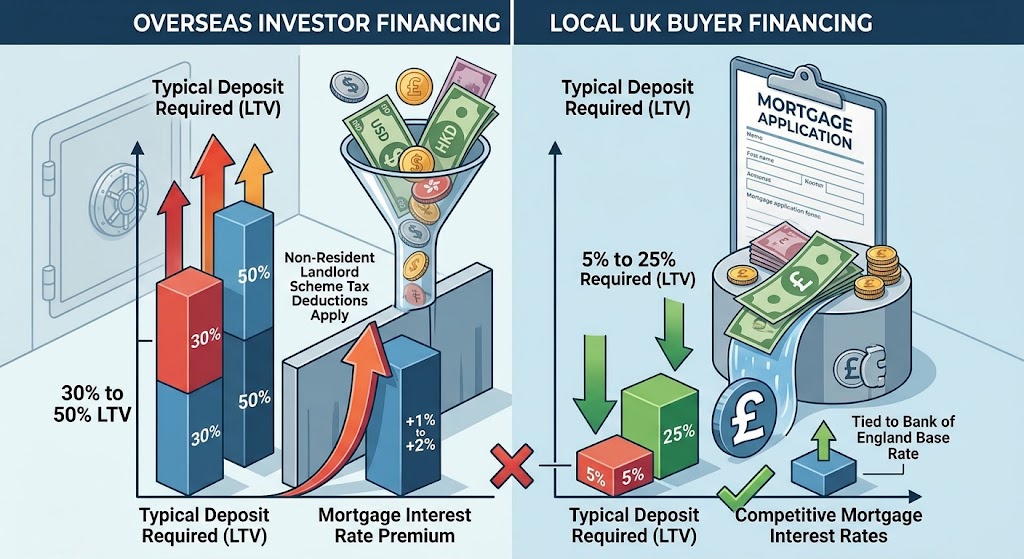
Because overseas buyers are geographically detached from their assets, their investment strategy relies heavily on distinct types of guarantees and assurances compared to local buyers. A local investor often adopts a 'hands-on' approach. They might purchase a distressed property on the secondary market, renovate it to add capital value, and self-manage the tenants to maximize yield. They are comfortable dealing with maintenance issues and void periods because they are physically present.
In stark contrast, the overseas buyer vastly prefers the 'Off-Plan' new-build sector. Buying off-plan involves purchasing a property before it is constructed, often locking in a lower price. To attract this international capital, UK developers frequently offer 'Rental Guarantees'. A rental guarantee is a contractual assurance where the developer or a partnered management company guarantees a fixed net yield (e.g., 6% per annum) for a set period, typically 1 to 3 years after completion. During this period, the management company handles everything: finding tenants, collecting rent, managing voids, and handling maintenance. The overseas investor receives a fixed, predictable income stream deposited directly into their account, treating the real estate almost like a fixed-income bond.
Local buyers rarely require or trust rental guarantees, as these schemes are often factored into an inflated purchase price. Locals rely on their own market knowledge to ascertain realistic market rents. For the overseas buyer, however, this guaranteed duration provides invaluable peace of mind, mitigating the immediate risk of void periods in an unfamiliar market. Even beyond the guarantee period, overseas investors are 100% reliant on Full-Service Property Management Agencies. They gladly sacrifice 10% to 15% of their gross rental income to agents to ensure compliance with over 150 pieces of UK landlord legislation (such as gas safety certificates, EPC ratings, and deposit protection schemes) which are too complex to manage from abroad.
The UK property market is a masterclass in duality. It seamlessly accommodates the domestic buyer striving for homeownership and local wealth accumulation, alongside the international investor seeking a robust, high-yielding safe haven for global capital. While both entities engage with the same fundamental asset class, share the same legal conveyancing pathways, and benefit equally from structural warranties, their journeys are markedly different.
Overseas buyers face a steeper barrier to entry. They must navigate a punitive tax regime, particularly regarding Stamp Duty surcharges, overcome stringent financing restrictions demanding much higher down payments, and untangle complex cross-border tax liabilities. Yet, despite these hurdles, the sheer volume of international capital flowing into UK real estate remains undiminished. The compelling cocktail of a historic housing shortage, phenomenal legal security, a world-renowned education sector, and opportunistic currency plays far outweighs the localized friction of taxes and fees. By heavily utilizing off-plan developments, developer-backed rental guarantees, and comprehensive property management services, overseas investors successfully bridge the geographic divide, transforming British bricks and mortar into a highly lucrative, globalized financial asset.